Europe is the second-largest region at USD 124,888.74 Million (15.09%), growing at the slowest regional rate of 3.79%, a function of high energy costs,
OR, UNITED STATES, August 31, 2026 /EINPresswire.com/ — The Steel Market is entering a period of structural transformation as infrastructure investment, automotive manufacturing, energy transition projects, and industrial development continue to generate demand for steel products. At the same time, producers are increasingly focusing on green steel, recycling, electric arc furnace technology, advanced grades, and lower-carbon manufacturing.
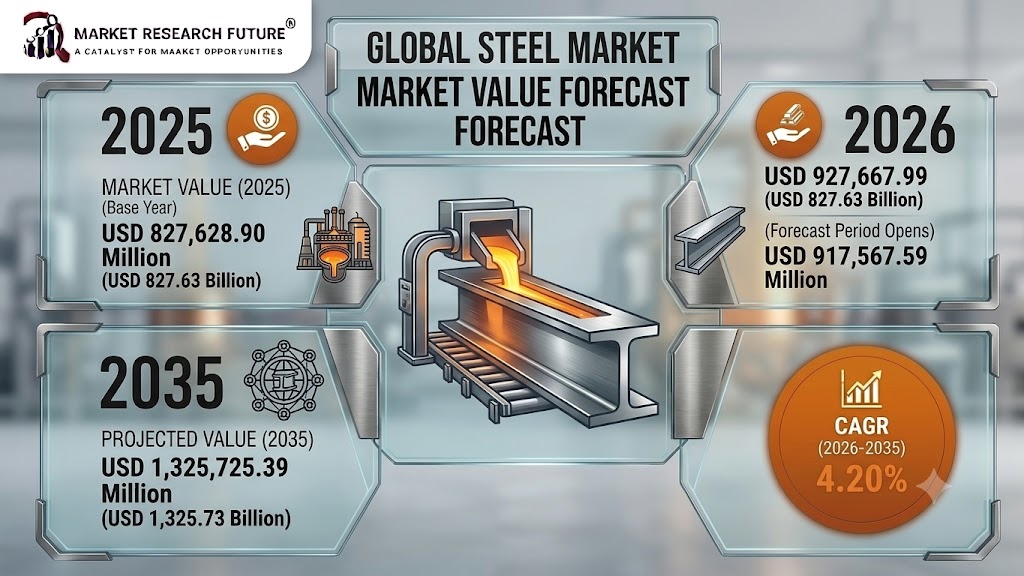
According to Market Research Future, the global Steel Market was valued at USD 827.63 billion in 2025 and is forecast to reach USD 1,325.73 billion by 2035, expanding at a 4.20% CAGR from 2026 to 2035. The market is expected to reach approximately USD 917.57 billion in 2026, reflecting a strong recovery in market value.
Infrastructure Investment Drives Steel Demand
Infrastructure development remains one of the most important contributors to the global steel industry. Governments and private developers continue to invest in roads, bridges, railways, commercial buildings, industrial facilities, power networks, and urban infrastructure.
Building and construction accounted for approximately USD 436.29 billion in 2025, representing 52.72% of the total Steel Market. The segment is expected to grow at a 3.90% CAGR during the forecast period.
Large infrastructure programs in emerging economies are particularly important for steel producers. India, Southeast Asia, the GCC countries, and parts of Africa are investing heavily in transportation networks, urban development, energy infrastructure, and industrial corridors.
These projects require substantial quantities of structural steel, reinforcement bars, plates, pipes, and other products, creating a stable foundation for long-term market demand.
Construction Remains the Dominant End-Use Segment
Construction continues to represent the largest end-use industry for steel. Steel’s strength, durability, recyclability, and versatility make it essential for structural frameworks, reinforcement, roofing systems, bridges, industrial facilities, and high-rise buildings.
Urbanization is another important factor. As populations become increasingly concentrated in cities, demand for residential buildings, commercial facilities, transportation infrastructure, and utilities continues to expand.
The continued development of smart cities and large-scale urban infrastructure is expected to support steel consumption throughout the forecast period.
Request Free Sample Copy: https://www.marketresearchfuture.com/sample_request/5465
Automotive Manufacturing Supports Advanced Steel Demand
The automotive industry represents another major source of steel consumption. Steel remains widely used in vehicle bodies, chassis, structural components, wheels, and other parts because of its strength and recyclability.
The automotive segment was valued at approximately USD 102.92 billion in 2025 and is projected to grow at a 3.87% CAGR.
The transition toward electric vehicles is also changing the requirements for automotive steel. Manufacturers increasingly need high-strength and lightweight grades that can improve vehicle safety while reducing overall weight.
Electrical steels are becoming particularly important for electric motors and related components, creating opportunities for specialized steel manufacturers.
Energy Transition Opens New Opportunities
The energy sector is emerging as one of the fastest-growing application areas for steel. Renewable energy infrastructure requires significant quantities of steel for wind turbines, solar installations, transmission systems, substations, and supporting infrastructure.
The energy application is projected to grow at a 5.98% CAGR, making it the fastest-growing application category in the market.
Offshore wind projects require large quantities of steel plates and structural components, while grid modernization creates demand for electrical and specialty steel products.
Hydrogen infrastructure, carbon capture and storage systems, LNG facilities, and desalination projects are also creating new opportunities for steel producers.
Electric Arc Furnaces Gain Momentum
Steel production is undergoing a major technological transition. Basic Oxygen Steelmaking remains the dominant manufacturing route, representing approximately 64.31% of 2025 market value.
However, Electric Arc Furnace technology is expanding more rapidly. EAF accounted for approximately 35.48% of market value in 2025 and is projected to grow at a 4.97% CAGR, compared with 3.69% for Basic Oxygen Steelmaking.
EAF technology can use scrap steel as a major raw material and can support lower-carbon production when powered by low-emission electricity.
As governments and steel companies pursue decarbonization targets, investments in EAF facilities and scrap-recycling infrastructure are expected to increase.
Green Steel Becomes a Strategic Priority
Sustainability is becoming one of the defining trends across the steel industry. Conventional steelmaking is energy intensive and generates significant carbon emissions, encouraging producers to develop lower-emission alternatives.
Green steel initiatives include greater use of scrap, electric arc furnaces, renewable electricity, hydrogen-based reduction technologies, carbon capture, and improved energy efficiency.
Steel producers are increasingly investing in technologies designed to reduce carbon intensity while maintaining product quality and production capacity.
The transition toward green steel could also create premium markets for lower-carbon products, particularly among automotive manufacturers, renewable-energy developers, and construction companies with ambitious emissions targets.
Buy Now: https://www.marketresearchfuture.com/checkout?currency=one_user-USD&report_id=5465
Carbon Steel Maintains Market Dominance
By steel type, Carbon Steel remains the dominant category. It represented approximately USD 754.40 billion in 2025, equivalent to 91.15% of market value, and is projected to grow at a 4.12% CAGR.
Carbon steel remains widely used because of its relatively competitive cost, strength, machinability, and suitability for construction and industrial applications.
Stainless steel, however, represents an important higher-value opportunity. It is projected to grow at a 5.24% CAGR, supported by demand from chemical processing, desalination, energy infrastructure, and other corrosion-sensitive applications.
Flat Steel Expands Across Automotive and Manufacturing
Flat steel represents the largest product family, accounting for approximately 57.02% of the market in 2025. The segment was valued at about USD 471.89 billion and is projected to grow at a 4.38% CAGR.
Flat products include sheets, coils, plates, and other forms used extensively in automotive manufacturing, appliances, construction, machinery, and energy applications.
The growing demand for advanced automotive materials and high-performance industrial products is expected to support continued expansion in this category.
Plates represent the fastest-growing flat-steel subsegment, with a projected 5.39% CAGR. Demand is being supported by wind towers, pressure vessels, shipbuilding, and energy infrastructure.
Recycling Strengthens the Circular Economy
Steel’s recyclability provides an important advantage as industries move toward circular production models. Scrap steel can be processed through EAF facilities and reused in new products.
Increasing scrap availability and improved recycling technologies can reduce raw-material requirements and potentially lower production emissions.
Europe, North America, Japan, and other mature markets have established scrap-collection systems, while emerging economies are increasingly developing recycling infrastructure.
The growth of recycling is expected to become increasingly important as steel producers seek to reduce production costs and carbon intensity simultaneously.
Asia-Pacific Leads the Global Market
Asia-Pacific is the dominant regional market, accounting for approximately 63.68% of global Steel Market value in 2025. The region generated approximately USD 526.99 billion and is projected to grow at a 4.10% CAGR.
China remains the largest individual market, accounting for approximately 40.68% of global value, while India represents approximately 9.07%.
India is particularly significant because its steel market is projected to grow at a 5.93% CAGR, making it one of the fastest-growing major economies in the market.
Infrastructure development, industrialization, automotive production, housing construction, and energy investment are expected to support demand throughout the region.
Middle East and Africa Show Strong Growth Potential
The Middle East and Africa region is projected to record the fastest regional growth, with a 5.63% CAGR. The region’s market was valued at approximately USD 47.96 billion in 2025.
GCC countries are investing in infrastructure diversification, renewable energy, hydrogen projects, transportation networks, and large-scale urban developments.
African economies are also increasing investments in infrastructure and industrial development, creating new opportunities for steel producers and distributors.
Europe Focuses on Low-Carbon Production
Europe represents the second-largest regional market, valued at approximately USD 124.89 billion in 2025. The region is projected to grow at a 3.79% CAGR.
Although growth is comparatively slower, Europe remains strategically important because of its advanced steelmaking capabilities and strong focus on decarbonization.
European producers are investing in EAF technology, hydrogen-based production, recycling, and energy-efficient manufacturing.
The region’s carbon policies and environmental standards are also influencing global steel supply chains by encouraging manufacturers and downstream industries to track and reduce embedded emissions.
Report Summary: https://www.marketresearchfuture.com/reports/steel-market-5465
Technological Innovation Reshapes Steel Manufacturing
Technology is becoming increasingly important for improving productivity, reducing costs, and lowering environmental impacts.
Digital manufacturing, artificial intelligence, predictive maintenance, automation, advanced sensors, and data analytics are helping steel mills improve production efficiency.
Manufacturers are also developing high-strength, lightweight, corrosion-resistant, and specialty steel grades for demanding applications.
These technologies can help producers respond to changing customer requirements while improving operational efficiency.
Competitive Landscape
The global Steel Market includes major companies such as ArcelorMittal, BAOWU Steel Group, Ansteel Group, Nippon Steel Corporation, HBIS Group, and JIANGSU SHAGANG Group.
Competition is increasingly focused on production efficiency, geographic expansion, advanced steel grades, recycling capabilities, and decarbonization.
Leading companies are investing in EAF facilities, low-carbon technologies, renewable energy integration, and partnerships with automotive and energy companies.
Strategic agreements between steel producers and major industrial customers are also becoming more important as buyers increasingly consider carbon intensity and product specifications alongside price.
Related Report
Welded Stainless Steel Pipes & Speciality Gases Market https://www.marketresearchfuture.com/reports/welded-stainless-steel-pipes-speciality-gases-market-68362
Iron and Steelmaking Market https://www.marketresearchfuture.com/reports/iron-steelmaking-market-68385
Sintered Steel Market https://www.marketresearchfuture.com/reports/sintered-steel-market-12039
Carbon Steel Market https://www.marketresearchfuture.com/reports/carbon-steel-market-10298
crude steel market https://www.marketresearchfuture.com/reports/crude-steel-market-9833
structural steel fabrication market https://www.marketresearchfuture.com/reports/structural-steel-fabrication-market-23675
precision stainless steel market https://www.marketresearchfuture.com/reports/precision-stainless-steel-market-23427
steel drums market https://www.marketresearchfuture.com/reports/steel-drums-market-10260
steel wire plastic rope market https://www.marketresearchfuture.com/reports/steel-wire-plastic-rope-market-30421
Market Research Future
Market Research Future
+ +1 855-661-4441
email us here
Legal Disclaimer:
EIN Presswire provides this news content “as is” without warranty of any kind. We do not accept any responsibility or liability
for the accuracy, content, images, videos, licenses, completeness, legality, or reliability of the information contained in this
article. If you have any complaints or copyright issues related to this article, kindly contact the author above.

Media gallery