New discussion explores how dashboards help identify patterns while deeper understanding remains essential for interpreting human behavior and decision-making.
LONDON, LONDON, UNITED KINGDOM, June 8, 2026 /EINPresswire.com/ — As organizations continue to invest in analytics and research technologies, the growing reliance on dashboards has transformed how teams monitor trends, track performance, and measure outcomes. However, research experts increasingly note that visual metrics alone may not provide the full context needed to understand the motivations, emotions, and experiences that influence human behavior.
Dashboards have become a central component of modern research and decision-making workflows. By consolidating large volumes of quantitative and qualitative data into accessible visual formats, dashboards help teams identify patterns, monitor changes over time, and communicate findings more efficiently. Yet industry observers suggest that dashboards are most effective when used as a bridge between data and deeper investigation rather than as a substitute for understanding.
In qualitative and mixed-methods research, numerical trends often raise important questions that require further exploration. A sudden shift in customer sentiment, a decline in engagement, or an emerging behavioral pattern may be visible through reporting tools, but understanding why those changes occurred frequently requires direct examination of participant feedback, interviews, discussions, and contextual data.
“Dashboards play an important role in surfacing patterns and helping organizations prioritize areas for investigation,” said a spokesperson for Terapage. “However, meaningful research often comes from connecting those patterns with the human stories and experiences that explain them. Data visualization and human understanding work best when they complement one another.”
The increasing availability of artificial intelligence has further expanded the capabilities of research platforms. AI-assisted tools can help researchers summarize responses, identify themes, analyze transcripts, and organize large datasets more efficiently. Researchers and technology providers alike continue to emphasize the importance of validating findings against original participant data and maintaining human oversight throughout the analytical process.
Industry studies and ongoing discussions within the research community indicate that AI and analytics tools can significantly accelerate insight generation, particularly when managing large-scale qualitative datasets. At the same time, many researchers view interpretation, contextual understanding, and critical evaluation as essential components of the research process that remain difficult to fully automate.
As organizations seek faster access to insights, many research leaders are adopting approaches that combine automated analysis with human expertise. This model enables teams to leverage dashboards for pattern recognition while using qualitative methods to uncover the context, motivations, and experiences behind the numbers.
The discussion reflects a broader shift within the research industry toward balancing efficiency with depth. Rather than replacing understanding, dashboards are increasingly viewed as tools that help researchers move more quickly from observation to investigation, ultimately supporting more informed decisions.
About Terapage
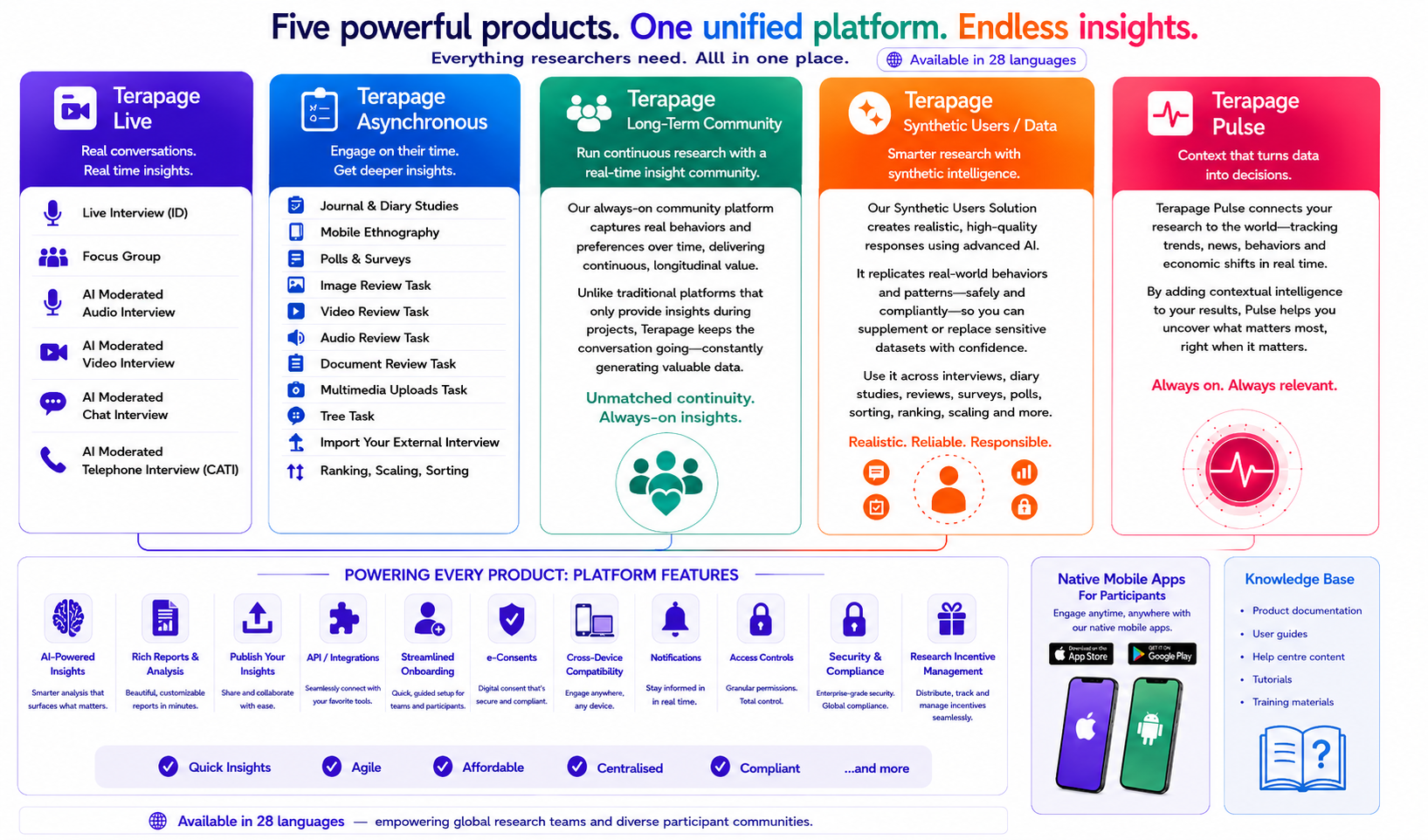
Terapage is an AI-driven qualitative and quantitative research platform designed to help organizations collect, manage, analyze, and interpret research data. The platform supports a wide range of methodologies, including online communities, diary studies, surveys, video interviews, multimedia feedback activities, AI-assisted transcription, thematic analysis, and reporting workflows.
Sarah Kensington
Terapage
+44 7445 049096
email us here
Visit us on social media:
LinkedIn
Facebook
YouTube
X
Bring participants together and uncover richer insights with Terapage’s Focus Group Activity
Legal Disclaimer:
EIN Presswire provides this news content “as is” without warranty of any kind. We do not accept any responsibility or liability
for the accuracy, content, images, videos, licenses, completeness, legality, or reliability of the information contained in this
article. If you have any complaints or copyright issues related to this article, kindly contact the author above.

Media gallery